

TABLE HEPTATHLON

Xiangqi
The rules.

Ancient xiangqi diagram.
-
The game is played on the intersections of 9 vertical lines (files) and 10 horizontal lines (ranks) that divide the board.
-
The two players command identical forces, alternating moves of a single piece at a time.
-
The red player opens the game and the black player replies. It is not possible to forfeit the right to move, as not being able to make a move immediately loses the game.

Initial arrangement of the pieces.
-
The river (河 hé) divides the two camps, between the fifth and sixth ranks. The river is usually marked with the phrases 楚河, meaning "River of the Chu", and 漢界 (hàn jiè), meaning "Border of the Han", a reference to the Chu–Han War.
-
There are two areas, centered at the first to third and eighth to tenth ranks of the board, each three points by three points, provided with additional diagonal lines that connect the corners to the centre. Each of these areas is known as 宮 (gōng), the palace.
The pieces.
-
The General: Moves and captures orthogonally, one step at a time, and is restricted to his own palace. A very important rule is that the two generals cannot face each other without interposing pieces. This rule can heavily influence mating attacks and endgames.


Possible moves of the General in his palace (represented by blue stones)
-
The Advisors: These pieces are defensive by nature, giving protection to the General inside the palace, that they cannot leave. Their moves are diagonal, one step at a time, so they can only reach five of the nine points that configure the palace. They capture as per usual, on the landing point.


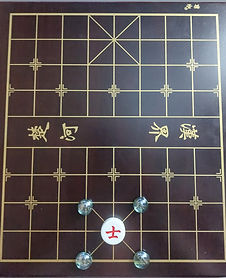
Possible moves of an Advisor inside the palace.
-
The Elephants: They are the second defensive unit, as they cannot cross the river, and so they never threaten to reach the enemy camp.
They move two steps diagonally at a time, and capture on the landing point.
However, they cannot jump over any piece that may stand midway between the point of origin and the destination. Blocking the Elephant this way is called "blocking the Elephant's eye" and can be an important attacking tactic.


Possible moves of an Elephant: on an open board and when it's partially blocked by other pieces.
-
The Horses: They begin the game next to the Elephants, one point closer to the rim. A horse moves one point orthogonally and then one point diagonally away from its former position, capturing on the landing point.
The horse does not jump as the knight does in Western chess, and can be blocked by a piece of either colour located next to it, on the point it would go through in the first part (orthogonal) of its movement. See diagrams below.
Blocking a horse in this manner is called "fettering the horse's leg", and can lead to a major restriction of its moves and an increased vulnerability.


Possible moves of a Horse when blocked by an adjacent soldier: two of its potential destinations are not within its reach.

It is possible for a horse (red) to attack another enemy horse (black) without being within its range, when the enemy horse (black) is blocked as in the figure.

Possible moves of an unhindered horse in the middle of the board.


Different configurations of the pieces restricting the red horse's movements.
-
The Chariots: They begin the game at the corner points. Their moves and captures are analogue to the Rook's in Western chess, which makes them the most powerful piece on the xiangqi board. Given the tactical nature of the game and the open files that usually appear, one Chariot is usually considered more valuable than any combination of two other pieces during the middlegame.


-
The Cannons: At the start of the game, the cannons are placed two ranks in front of the horses, eyeing the enemy horse. They move orthogonallly like Chariots, but do not capture in the same way: to capture an enemy piece, they need 'a screen', in the form of another piece interposed between them (see diagrams).
It is commonly thought that cannons are more powerful than horses at the start of the game, since there are still many pieces on the board and so, they can easily find screens to attack.
But as the game evolves into an endgame, horses gain mobility while cannons lose potential, finding it more difficut to use screens.


Diagram depicting the capture of a red chariot by a black cannon.


Legal moves of a red cannon in two different positions. In both of them, a black chariot can be taken.
-
The Soldiers: Each side starts with five soldiers, placed at the forefront of their armies. Before crossing the river, they move forwards one step at a time and capture in the same way. But once they've crossed the river, their value increases, as they get lateral moves and captures, as well as forwards.
Once they reach the final rank, they do not promote, but they can still move sideways.


Legal moves of three different red soldiers, before and after crossing the river.
Winning the game.
-
By delivering checkmate to your opponent.
-
By stalemating your opponent (when he runs out of legal moves)
-
Perpetual checks with one or various pieces are not allowed and result in a defeat for the checking player.
-
Perpetual chases of any one unprotected piece with one or more pieces, excluding generals and soldiers, are similarly prohibited.
-
If one side perpetually checks and the other side perpetually chases, the checking side has to stop or it will be ruled to have lost the game.
-
If a player deliberately makes an illegal move, like 'facing the generals', it's understood that he has resigned the game.
-
The game can be resigned at any time.
Drawing the game.
-
For want of material on the board to deliver checkmate.
-
When neither side violates the rules and both persist in repeating the position without making an alternate move, the game can be ruled as a draw.
-
When both sides violate the same rule at the same time (note that unlike in western chess, a mutual perpetual check is possible) and both persist in not making an alternate move, the game can be ruled as a draw.

Xiangqi Endgames collections.

Xiangqi ECCO.
